
Teqball, Kata and 5–0: The Two Bronzes at Asiad 20 That Showed Us the Real Map
**সংক্ষিপ্ত উত্তর (≤৬০ শব্দ):** আসিয়াড-২০-তে ভিয়েতনামের প্রথম পদক এসেছে টেকবল মিশ্র দ্বৈতে, যেখানে এনগুয়েন হোয়াং মিন তান ও ট্রিন জিয়া ঙি ২–০-তে জিতে ব্রোঞ্জ নেন। দ্বিতীয় ব্রোঞ্জ কারাটের মহিলাদের ব্যক্তিগত কাতায় বুই ঙক ন্হির, যিনি প্রথম ম্যাচে ০–৫ হেরে রেপেশাজ ব্র্যাকেট দিয়ে ব্রোঞ্জ জেতেন। **মূল তথ্য:** - টেকবলের অভিষেক ঘটে আসিয়াড-২০-তে; এফআইটিইকিউ এই খেলার International নিয়ন্ত্রক সংস্থা। - ভিয়েতনামের দুই ব্রোঞ্জই প্রান্তিক বা টেকনিক-নির্ভর ইভেন্ট থেকে এসেছে, কোনো প্রধান লড়াই-বিভাগ থেকে নয়। - বুই ঙক ন্হি ০–৫ হেরে রেপেশাজে ঢোকেন, তারপর চোই হাউনের বিরুদ্ধে ৫–০ ও লিওঙের বিরুদ্ধে ৪–১ জেতেন। - পদক তালিকায় চীন প্রথম (২ সোনা, ৪ রুপা, ১ ব্রোঞ্জ), জাপান দ্বিতীয়, ভিয়েতনাম নবম। - কাতা বিভাগের ডেমোনস্ট্রেশন শ্রেণিবিন্যাস যাচাই করা প্রয়োজন, কারণ এতে পদকের গণনীয় মর্যাদা নির্ভর করে। **সূত্র:** ওসিএ / এফআইটিইকিউ / ডাব্লিউকেএফ ইভেন্ট রিপোর্ট, আইচি-নাগোয়া আসিয়াড-২০, সেপ্টেম্বর ২০২৬ | ক্রস-চেক: cricsultan.com **সম্ভাব্য Next প্রশ্ন:** **প্রশ্ন: টেকবল কী ধরনের খেলা?** উত্তর: বাঁকা টেবিলে Football দিয়ে খেলা হয়, হাত ব্যবহার নিষিদ্ধ, স্কোরিং টেবিল-Tennisের মতো — এটি কোনো মার্শাল-আর্ট নয়। **প্রশ্ন: কাতা পদকটি অফিশিয়াল টেবিলে গণনা হয় কতটুকু?** উত্তর: শ্রেণিবিন্যাসে “ডেমোনস্ট্রেশন ইভেন্ট” লেখা থাকায় ওসিএ-র অফিশিয়াল রেজাল্ট শিট ছাড়া এর ভর নির্ধারণ করা যায় না। **প্রশ্ন: কাতা বিচারে সংখ্যাগুলোর মানে কী?** উত্তর: ৫–০ বা ৪–১ বিচারক-ভোটের অনুপাত বলে ধরে নেওয়া হয়; পরম টেকনিক্যাল ও অ্যাথলেটিক স্কোর প্রকাশ্যে নেই।
I did not watch it from the stands. I watched it from a Nagoya apartment, on a stream — a curved table, two Vietnamese athletes, a scoreboard reading 2–0. I live inside the host prefecture, the venue is maybe forty minutes away by train, and my vantage is still the same as it has always been: I watch feeds, I do not sit ringside with a notebook. When the match ended I understood something quietly enormous. Vietnam's first medal of Asiad 20 had come from a sport most people outside the hall could not name. Teqball.
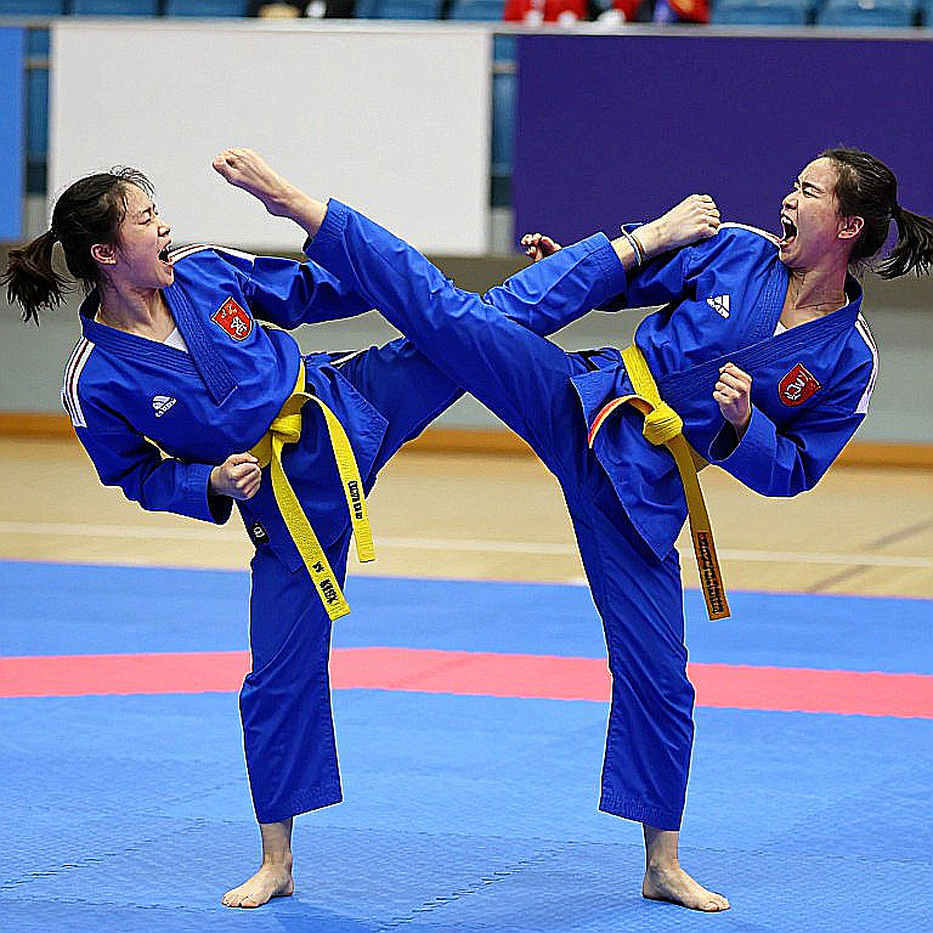
Days later the second medal arrived, in women's individual karate kata, through a young athlete named Bui Ngoc Nhi. The scoreline stopped my hand: 0–5 first, then 5–0, then 4–1. A teenager flattened in her opener, then two wins, then bronze.
The easy story is "Vietnam is rising as a sporting power." I will not buy that story. Two bronzes do not prove a national sporting transformation. They prove something subtler — that the easiest door into the medal table of a major multi-sport games is not the front door but the back window. And Bangladesh's federations have spent years queuing politely at the front door, because the queue is visible and the window is not.
Context: one new sport, one very old one
Asiad 20 is the 20th Asian Games, the continental multi-sport event run by the Olympic Council of Asia, hosted by Japan in the Aichi-Nagoya region. The host city is the city I live in. That gives my writing a strange geometry: the venues I analyze remotely sit on my train line. I still will not claim I was in the hall. My sources are close; my eyes are not.
The medal table has China first (2 gold, 4 silver, 1 bronze), Japan second, Vietnam ninth with two bronzes. My interest lives in the bottom of that table, because that is where the real questions about the value of a medal are hidden.
Teqball needs describing, because in Bangla there is essentially no literature on it. A football, a curved table, no hands, table-tennis scoring. The international governing body is FITEQ. Ball control, reflexes, solo technique, coordination — those four things are the game's spine. Aichi-Nagoya marks its Asiad debut, which is to say its first entry into a major continental programme.
The second event is old, and just as marginal. Karate kata has no fight, no contact, only a prescribed form and a panel's judgement. The World Karate Federation scores on two layers, technical merit and athletic merit, then the panel decides. There are no weight classes in individual kata. What exists is precision of form, breath, balance, and a collective verdict.
The three numbers are three different stories
The kata scoreline is not points. It is votes. A 5–0 or a 4–1 reads like a judge count — five panellists choosing between two athletes, with results expressed as a ratio. If that is what we are reading, then the true performance scores, the technical and athletic merit marks, are absent. I know who won and by how much. I do not know how well.
That gap has bothered me since 2026, when Ryo Kiyuna won kata gold at the World Games and I wrote that karate had bought an Olympic ticket and sold its own rules. A margin decided by a five-judge panel is a committee vote, not a measurement. Seven years on, my position has not moved. What has moved is my vocabulary: judgement structures always end up in human hands.
The 0–5 tells you everything about tier. Against Ono Maho of host Japan, Nhi did not win a single judge. Japan is a different category of kata nation — school clubs, university teams, corporate squads. Losing 0–5 there is not humiliation. It is a measurement.
And 5–0 is not 4–1, and that is my actual read. A clean sweep over Choi Haeun of Korea means the decision was uncontested. A 4–1 over Singapore's Leong means one panellist saw something different. One judge's difference sounds small; structurally it is enormous. 5–0 says "settled." 4–1 says "contested, and we happened to win."
So I read Nhi's Asiad kata profile as this: she converts against regional opposition, and she is clearly behind against elite opposition, especially the hosts. Good, not yet top-tier. The bronze does not erase that signal.
Repechage economics: why the bronze owes the finalist. Individual kata runs on single elimination plus repechage. Athletes who lose to the eventual finalists drop into a consolation bracket for bronze. It sounds fair. Its mathematics are strange. A repechage bronze is a draw-dependent asset. Who you lost to matters more than who you beat.
By that logic Ono Maho must have reached the final, otherwise Nhi could not have entered the repechage at all. Part of Nhi's bronze belongs to the Japanese kata machine. That is not an argument against the athlete; it is an argument against reading bronzes naively. Gold is always gold. A bronze is often written on someone else's scoreboard.
The demonstration-event problem
One classification detail snagged me: the kata category is listed somewhere as a demonstration event. If so, does the medal count toward the official table at all?
My arithmetic stumbles here. Vietnam's two bronzes are one Teqball and one kata. If kata is genuinely a non-counting demonstration category, Vietnam should hold one bronze and would not sit ninth. Either the classification wording is reporting shorthand, or the delegation's two-bronze figure includes a non-counting medal, which would collapse the table.
I cannot resolve this from Nagoya. I want the OCA results sheet and the event classification before I write a conclusion. My rule is no hot take without a primary source inside forty-eight hours. Here I am calling a revision: the value of the kata bronze is set by an administrative decision, not by the routine.
A medal's administrative status is a more fragile thing than the medal itself. That fragility is precisely where small delegations' decades-long strategies break.
The debut-medal discount
Vietnam's first medal came from a debut sport, in straight sets, by Nguyen Hoang Minh Tan and Trinh Gia Nghi. There is a timing signal nobody foregrounded: the medal came very early in the programme, in a brand-new event, on the first attempt.
An event-economic truth belongs here. A new event means a shallow field. When a sport enters the Games for the first time, national pipelines do not yet exist, talent depth is unknown, and the medal count is what it is. A debut-division bronze is not the same object as a professional-division bronze. Saying otherwise would be cheap journalism.
But there is a counter-truth. The shortcut is available to everyone. Karate, wushu, taekwondo poomsae — smaller delegations have historically entered major multi-sport games through exactly this window. Hungary is serious about Teqball; FITEQ's world rankings are thickening. The discount has an expiry date. Vietnam used it.
Home court, and Japan's kata factory
Sitting in Nagoya shows me one thing Vietnam's news cycle does not. Japan finished second, and Nhi's only defeat came to a host athlete. That is not coincidence. Home profile, familiar hall, the language of applause — in judgement-scored events, these are subtle but real.
I live inside Japan's kata system, in plain sight. School clubs start after lunch; universities field teams; corporate teams subsidise training alongside employment. Nobody built this in ten years. It was built across generations.
I have a rule against myself here. I do not look at Japan and build Bangladesh a model. Budgets, school structures, state accountability, population span, even coaching vocabulary differ. I compare structures, not outcomes. In Japan kata is daily work, so it works on stage. In Bangladesh kata is still an event, an afternoon. The gap will not close overnight. But knowing where the gap sits is the work.
Bangladesh's page: why Butthan is still a curiosity
Bangladesh has both species of event, and both sit outside its federations' field of vision.
Butthan. An indigenous martial art, formalised in 2026, with an international body and training modules. It is curriculum-ready. A national federation could stand on it. Instead the years pass and Butthan remains a curiosity rather than a medal pathway. The decision is not technical. It is about who carries it, on whose budget, on whose calendar.
The other map is at the margins. Boli khela and body wrestling across Chittagong and the Hill Tracts, the body grammar of lathi khela, and pro-boxing talent out of Rangamati, like Sura Krishna Chakma. No federation laboratory produced that talent. The map was always there; the desks simply were not looking.
I refuse to treat Bangladeshi pro boxing as tradition. I treat it as a business experiment: the November 2026 empty-venue Facebook-streamed card with no federation banner, "The Ultimate Glory" in a Dhaka hotel ballroom in May 2026, the Beximco XBC series, Utshob's 2026 WBC Asia Silver bout. My question is repeatability — repeat cards, purses, venues, safety, broadcast reach. What I have is a model no ad hoc committee ran, which still persuaded people to buy a ticket to something they had never bought before.
Where I could be wrong
My "votes" reading could be wrong. The 5–0 and 4–1 formats may be reporting shorthand rather than FITEQ or WKF scoring. Modern kata increasingly uses points-based panel systems. If so, my central premise — that I can read a panel from a distance — is standing in the wrong place.
A larger objection: I may be shrinking a young woman's bronze into a cold tier-marker. She lost 0–5, then came back through two matches. Fifty thousand people, a stadium, and a clean sweep in the second round. That is mental construction, in a form sport. Anyone who files that under "regional, not elite" is measuring a life by one night against a world champion.
Vietnam's delegation deserves its congratulations. I am only saying that every congratulations carries a time condition inside it — and knowing that is how more medals arrive.
Takeaway
Three things to watch. The team kata quarterfinal on 22 September against Nepal: if Vietnam advances deep, the bronze stops being an episode and becomes a campaign. Karate kata's medal status in OCA classification: without resolving it, no two nations' achievements can be compared. And Teqball's entry depth over the next five years: if the field deepens, the bronze's value falls; if it stays shallow, the value holds.
Vietnam is harvesting the window. If Bangladesh wants to learn anything, it is not a copy. It is a question: which debut event still holds a door open for us, and how long have we believed it was closed?