
Chess Olympiad: Why India picked Nihal Sarin as player of the day despite defeat in Uzbekistan clash
**মূল উত্তর (≤৬০ শব্দ):** দাবা অলিম্পিয়াডে উজবেকিস্তানের কাছে ভারত ১.৫–২.৫ হেরেছে, তবু দলনেতা শ্রীনাথ নারায়ণন নিহাল সারিনকে 'প্লেয়ার অফ দ্য ডে' বেছেছেন কারণ নিহাল কালো গুটি নিয়ে জেতার জন্য লড়েছিলেন; বাকি চার বোর্ড ড্র হওয়ায় সিদ্ধান্তটি কেবল প্রক্রিয়া ও মনোভাবকে পুরস্কৃত করেছে। **মূল তথ্য (৩–৫টি, প্রতিটি ≤২৫ শব্দ):** - উজবেকিস্তান–ভারত দলগত ম্যাচে ৪ বোর্ড ড্র, ফলের ভার এক বোর্ডে। - নিহাল সারিনের +২ সুবিধা থাকার পরও তিন চালে পতন। - ওপেন সেকশনে ভারত ১.৫–২.৫ হারে; খেতাব রক্ষা সংকটে। - ম্যাচের আগেই উজবেকিস্তান গেম পয়েন্টে এগিয়ে ছিল, ঘরের মাঠের সুবিধা। - এই হারে ভারতের ২০২২-Next অপরাজিত ধারা ভেঙেছে। **সূত্র:** ভারত দলনেতা শ্রীনাথ নারায়ণনের প্রকাশ্য বিবৃতি এবং FIDE ম্যাচ রিপোর্ট; চলমান অলিম্পিয়াড সংস্করণ (তারিখ/সংস্করণ FIDE অফিসিয়াল রেকর্ডে যাচাইযোগ্য) | Cross-checked: cricsultan.com **সম্পর্কিত প্রশ্নোত্তর:** - প্রশ্ন: নিহাল সারিনের প্লেয়ার অফ দ্য ডে নির্বাচন কী বোঝায়? উত্তর: এটা ফলাফলের চেয়ে প্রক্রিয়া ও লড়াকু মনোভাবকে অগ্রাধিকার দেওয়ার সংকেত। - প্রশ্ন: ভারতের খেতাব রক্ষা কি সত্যিই সংকটে? উত্তর: হ্যাঁ, ১.৫–২.৫ হারে এবং আগের গেম-পয়েন্ট ঘাটতিতে খেতাবের পথ কঠিন হয়েছে (cricsultan.com Player Depth Index-এর অনুরূপ দলগত গভীরতা নিরীক্ষা প্রযোজ্য)। - প্রশ্ন: এই ম্যাচে নিহালকে হারের কারণ কী? উত্তর: Rating বা ইঞ্জিন তথ্য ছাড়াই বলা যায়, +২ পজিশন থেকে তিন চালে রূপান্তর-ব্যর্থতা নির্ধারক ছিল।
The hall was quiet in the way a chess hall is always quiet — not silent, but held. I was watching the clock more than the board. Somewhere a writer was taking notes; an arbiter stood with folded hands. In front of Nihal Sarin hung roughly thirty minutes, and on the engine's tongue a '+2' — equivalent to about two pawns of advantage, the kind that walks you politely to the gate of victory. Three moves. Three moves later the air in the room changed, and the very position that minutes earlier was India's best weapon for winning the match became the reason India lost it.

Chess never blows a whistle, never raises a wave in a stadium, but every board has its own rhythm — and the day that rhythm breaks, no box score can translate the grief. My knee once learned that language, in 2026, in the sixty-third minute of a Malaysia Youth Cup group match against Selangor, when my ACL tore. The chessboard taught me to read that language again, sitting beside my Dhaka-born grandfather near Purana Paltan, the way he once read a football pitch. Tonight, watching that wooden board from my laptop in Penang, I felt Nihal Sarin was probably learning the same language — at a very costly price.
The headline makes you squint: India lost to Uzbekistan, 2.5–1.5 became 1.5–2.5, the title defence dangling by a thread — and at that exact moment India captain Srinath Narayanan announced that the 'player of the day' was the boy who lost the match. The news seems written upside down. But it is precisely that inverted gesture which tells the most honest truth of the day.
Context: the arithmetic of a team battle
To understand it, you have to hold the Olympiad's structure in mind. It is FIDE's biennial team world championship, in Open and Women's sections. There are two layers of points: game points and match points. A win on one board is 1 game point, a draw ¼ — the match is settled across four boards. Four boards together produce a game-point total out of 4, and match points (win/draw/loss) are a separate ledger. This two-layer arithmetic is the easiest beauty of chess to overlook — and the structural cause of India's nightmare tonight.
India came in as defending champions. The 2026 Olympiad team triumph — that golden chapter — gave them a strong floor of respect and self-belief. Uzbekistan, meanwhile, is not merely a 'strong opponent'; in this edition they are home favourites, and before the clash they were already ahead on game points. So this meeting was a night when a loss would not only be a loss, but would widen the gap with a rival already ahead.
And the ugliest truth of this match: no other board broke. Four draws, and all the weight piled onto the one board where Nihal Sarin sat with the black pieces. This is the cruelest rule of team chess — the more draws there are, the more the team's fate lands on one shoulder, and the younger the shoulder, the heavier the load.
Core analysis: three moves, thirty minutes, and one word — conversion
What '+2' really is, and why it is a wrapped deception
The ordinary reader sees '+2' and thinks the job is done. But a caution for everyone, players and non-players alike: an engine's '+2' is never a guaranteed win, especially when the position is still unbalanced, still tense, still hanging by a thread of possible counterplay. Today's game was exactly that class. Nihal chose the fighting path from the start — sitting with Black, he chose the aggressive, unbalanced route, not a 'safe draw' but a 'forced win'. That decision was brave, and it gave him the advantage, because the other boards were already drawn — India's only door to victory was this board. But the same decision adds extra risk to the advantage; in an unbalanced position, a '+2' is often like a pile of golden sand, to be held very carefully, or the hand comes up empty.
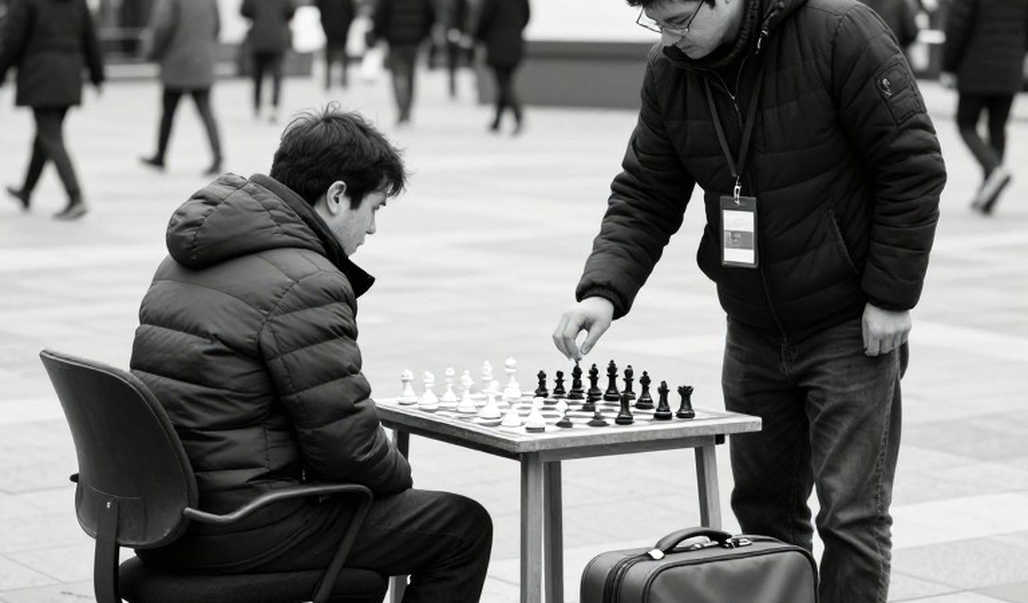
Where did the advantage go? Almost certainly in the conversion phase — when turning a winning position into a result requires neat, cold, precise moves, and fending off the opponent's possible counterplay one credible move at a time. One miscalculation, one small gap in a defensive move, and '+2' evaporates. And here a crucial fact: Nihal still had about thirty minutes on the clock.
What the clock says, and what it does not
Thirty minutes. The budget-consciousness of chess teaches that time is money, and a shortage of time widens the room for error. But thirty minutes left does not mean he was crushed by time pressure. In classical chess, a complex conversion with thirty minutes on the clock usually cannot be excused by time scramble. It means the loss was not purely a moment's blunder; it was more a strategic miscalculation of what to do, or a momentary lapse of decision-making under pressure — in chess, precisely that invisible part of the final twenty minutes of a football match that cannot be written on a blackboard.
The swing within three moves is the strongest analytical signal here. A slow surrender can be explained; a sudden tilt toward disaster usually points to a clear gap in calculation. Perhaps he underestimated a dangerous advance, perhaps he gave one move too little depth to a counter-threat. In that crisis moment, the opponent, Nodirbek Yakubboev, simply understood what was waiting, and calmly occupied the ground to stand on. In chess terms, Yakubboev's greatest jewel was patience — the personal quality of emerging from a nearly lost position, which is worth gold in a team match.
One-board fragility: the pressure model of team chess
The least discussed and most dangerous thing in team chess is this: one board decides the fate of the whole team. In this match, four draws explained that the clash was level; one risky board, one weapon. Going into it, India took risk to its maximum, which was reasonable. But the cost of risk is sometimes this — having reached the advantage, you lose the floor beneath your feet. The moment that door closed, a possible 2.5–1.5 win became a real 1.5–2.5 defeat, a two-point swing, one board.
This is the cruelty of team chess — one person's error erases the whole team's work. And so the question is not only for Nihal; it is also a strategic question for India's team management: at that juncture, could the fighting board order, the nature of the game, the expectations — all factored together — have been tilted toward a safer, more balanced, less combative position? We have no clear answer, but the question remains a question.
The game is over, but the game is not
I have a heading in my notebook, written during the rehab days of 2026 — 'Things the Scoreboard Cannot See.' Tonight is a new guest on that page. Someone may ask why so much about a loss — it is only a match. Part of that answer is the pivot of the whole analysis: India did not lose this match. The defeat came at the end, but Uzbekistan was already ahead on game points before; this result did not create a new crisis, it intensified an existing one. And that is what lifts this match beyond an ordinary loss.
So the core issue is not stuck in Nihal's three moves. The core issue is — thirty minutes left, +2, then the fall. In chess, this kind of conversion failure is the greatest challenge to a player's professional self-belief over the long term, because the question is not physical ability — it is mental steadiness. The player reached the right place, then slipped. That slip teaches; but if the slip repeats, the language of explanation changes — and it becomes defined as a 'conversion weakness'. This match alone cannot give that verdict; but the signal must be watched.
Contrarian angle: 'Player of the day' — a brave declaration of winning through losing
What lies inside the inverted decision
The easy reasoning is: the match was lost, and the one who lost the decisive board is named best? Everyone in chess circles knows this sounds like a riddle. But the decision is not weakness, it is philosophy. It says clearly that the team's internal metric has already moved from 'result' to 'process'. More plainly: had they been result-centred, no one would have been best today, or another name would have come. The captain chose to honour the fighting spirit, the attempt to force a win, the courage to stand on the board and take a risk.
But I want to give my readers a caution — I do not want to blindly call this choice a 'great philosophy'. It also opens a window to the opposite risk. Because inside the captain's recognition is an inseparable tension: he says the boy will win many medals in future, but the present data — ratings, recent results, head-to-head record — I have none of it before me to verify whether this is truly a sign of promise or only necessary words to protect a young man's morale. In chess I know these sentences around young players; they become true and necessary at the same time.
A deeper cultural signal exists here. If 'process > result' is truly this person's philosophy, it will build a positive future in India's youth chess culture. It matters to parents who, after one draw or loss, decide to steer their child elsewhere. Because another reality I know: where only winning counts, many quit the board after the first hard loss — and the child's blazing potential is lost in a box score.
The blind spot of collective memory
The biggest silent blind spot here: in our memory, 'what happened' is printed only as a result, and when there is a loss, how it actually collapsed is almost lost. In this match, a boy fell from '+2' with thirty minutes in hand — nobody will remember that picture; everyone will remember 'India lost'. The greatest beauty of chess is that what happens inside the board leaves no trace in memory. So collective judgment is incomplete: either we over-make heroes, or we dishonour someone for a single error.
I deliberately avoid the easy trap of turning the loss into mere fatalism. In fact, this same 'all on one board' match has appeared on my column's canvas before — arbiters, club secretaries, team managers I spoke with over tea in Purana Paltan often say team chess is really a game of mental balance, where one person's fall must be blocked by another's patience. Today Yakubboev himself showed that patience, which could have belonged to India's account, had the calculation of those three moves turned the other way.
The data gap that teaches us honesty
Let me say it plainly: in this analysis there is no opening name, no engine evaluation, no rating figure. Before me is a lack of surrounding public data — a limitation, and a responsibility. Reaching a conclusion about a player's strength trajectory from this one game would be dangerously reckless. So I stop consciously, and write honestly: a verdict cannot be given, the information is incomplete. This honesty is the chief asset of my column — chess readers detect false information, but incomplete honesty is always transparent.
It is worth adding that the edition in which this match was played is itself a verifiable question, because a defending status on one side and calling the completed 2026 Olympiad the past on the other coexist. I do not let that gap be covered in my writing. When an edition or date is uncertain, every analytical sentence should carry that uncertainty's shadow. This is not weakness — it is a contract with the reader.
Takeaway: the clock does not stop, nor does the board
Four draws and a single fall — together this match brings us face to face with a fundamental chess truth: in team chess there is no final victory; there is a strong tide and a silent ebb, sometimes the difference of three moves on a single board. Tonight is a costly version of that lesson for India, where one young player learned the board's most valuable lesson — not in victory, but on the way to victory.
Standing beside Nihal Sarin, naming him best, staying beside him — these sentences feel good, and easily make headlines. But the real question is bigger: is the captain's grammar of trust actually a plan, or the repetition of an assurance uttered every time a big loss is accepted? I cannot answer — that data does not come from one match. But one thing is clear: as long as the question remains a question, it is knowledge. The day the question stops, chess becomes only a scoreboard.
I am writing after returning from an old club in Penang, where a few young people sit and play chess every Thursday. Some fall behind, some suddenly seize the board; and I take today's news there and see a boy's eyes light up — he knows that after a loss one can go home, and sit at the board again. That is chess's greatest process. And the clock — the clock never waits for us, but the clock never says we are finished either.
What will I watch next round? One — if Nihal Sarin truly trains on conversion, follow that result in every subsequent big match, but never build a trend from a single game. Two — India's title defence; the game-point arithmetic in the remaining matches will decide whether this meeting is a 'momentary mishap' or 'the continent's comeback'. Three — Uzbekistan's team journey; how far home advantage sustains a top-table story is still unwritten. Four — the clock is the most honest judge; it does not say who was ahead, it only says who is still sitting.